
What is a post-tensioned concrete slab?
A post-tensioned concrete slab is reinforced with steel tendons that are stressed after the concrete has been poured and has gained strength, then locked off at anchors along the slab edges. That tension squeezes the concrete together, which helps the slab resist cracking and deflection. The tendons are not there as a backup. They are part of how the slab holds itself up.
Post-tensioning is common in modern suspended slabs and decks, which is why so many coring, cutting and drilling jobs in Sydney buildings start with a scan. Before anyone penetrates one, our slab scanning service in Sydney finds and marks the tendons so the hole goes where they are not.
Why a tendon is not like a reinforcing bar
Hitting a reinforcing bar with a core drill is a defect to repair. Cutting a post-tension tendon is a different order of problem. The tendon is holding stored force, and cutting it is a life-safety event and a structural failure at the same time. On a live site, the remediation cost is severe.
Tendons also curve through the slab rather than running straight and level. A single clear reading at the centre of a planned core does not mean the whole hole is clear, because a tendon can pass through the edge of the footprint at a different depth.
How to tell if a slab is post-tensioned
Start with the structural drawings. They will show whether the slab is post-tensioned and how the tendons were meant to be laid out, but a drawing is not a measurement of where each tendon ended up. The building manager or the structural engineer will usually know whether the slab is post-tensioned.
If there are no drawings and no one can confirm it, treat a suspended slab as post-tensioned until a scan shows otherwise. A scan takes a fraction of the time a repair would.
How tendons are found before you core, cut or drill
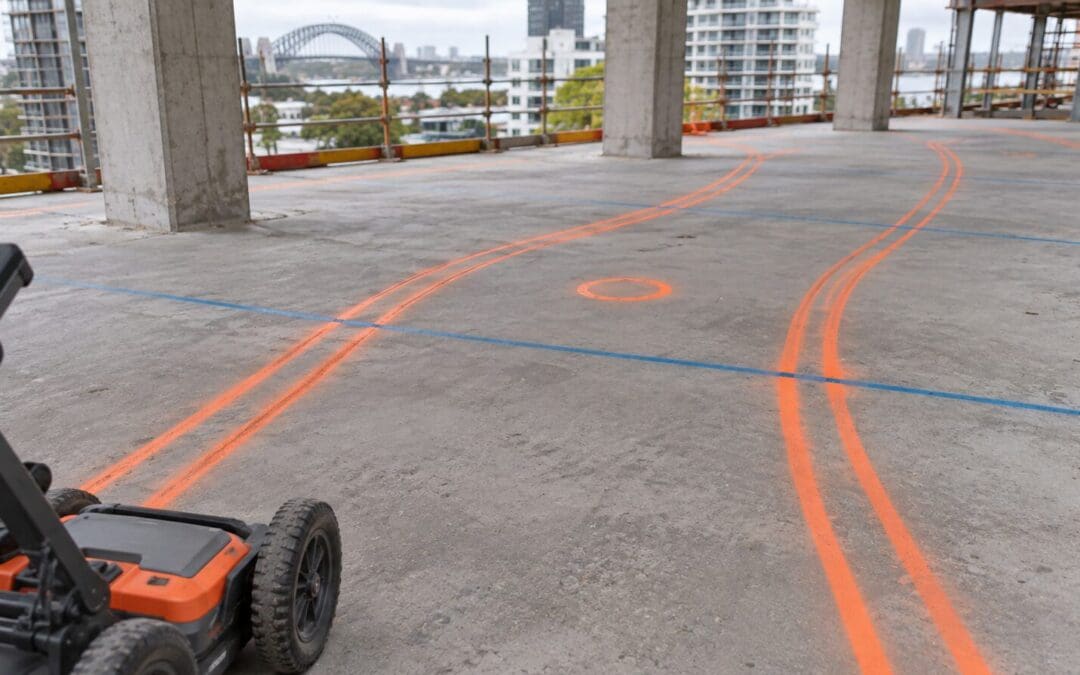
Tendons are found with ground penetrating radar. The scan needs only one face of the slab, uses no radiation and needs no exclusion zone, and it is read live on site. Our operators mark the tendon paths straight onto the concrete, along with the rebar, any conduits and the zones where a penetration can be made safely. If you are weighing up radiography, we compare the two methods in concrete x-ray versus GPR scanning.
On a post-tensioned deck we scan the full footprint of the penetration rather than a single point. What happens next depends on the job.
Before coring
Plumbing and electrical penetrations, riser holes and drainage need a core that lands between the tendons. The scan marks a clear zone for each core, so the person on the drill sees the same information as our operator.
Before cutting
Saw cuts for openings, stairs and lift shafts can cross several tendons, and a saw does not stop when it finds one. The scan shows where the tendons and reinforcement sit and gives an indication of the condition of what is there, so a structural engineer can decide where the opening can safely go.
Before drilling
Anchor bolts, hold-downs and fixings for balustrades and plant go in shallow, but even shallow drilling reaches mesh and conduit. Because a tendon curves, it sits closer to the surface in some parts of the slab than in others, so fixings need the same scan as a core.
What affects what the scan can see
GPR for concrete uses a higher frequency antenna, which resolves fine detail such as bar spacing but does not reach as far as the lower frequency antennas used in soil. Heavy reinforcement, high moisture content and dense mesh all reduce what the radar can see through. An anomaly on screen cannot always be identified on its own, so our operators record a confidence level against each target rather than presenting every reading as certain.
Booking a scan on a post-tensioned deck
Tell us the slab type, what you are penetrating and when you need it done. Our 24 hour service means scans can be done outside occupied hours in live buildings, and where the job needs a record we issue the scan as a plan in 12d, DWG or PDF. For walls, columns and other structures, see our concrete scanning service.
Call (02) 8753 0049 or request a slab scan.