
What people usually mean by concrete x-ray
Most searches for concrete xray come from someone about to core, cut or drill a slab who needs to know what is inside it first. Many of them need a ground penetrating radar (GPR) scan rather than radiography. Both methods look inside concrete, but they work very differently, and the difference decides how much disruption the scan causes on your site.
Concrete scanning tells you what is inside a slab before you cut into it: reinforcement, post-tension cables, conduits and anything else cast in. Locate & Map does that work with GPR across Sydney, and our page on concrete scanning before coring covers the service itself. This post explains what radiography involves, how GPR compares, and how to work out which one your job needs.
How radiography works on concrete
Concrete radiography is the closest thing to a medical x-ray. Radiation passes through the slab and records an image on the far side, so the method needs access to both faces of the concrete: the source on one side, the film or detector on the other. On a suspended slab that means working on two levels at once. A slab poured on the ground has no second face to work from.
Because it uses ionising radiation, the work area has to be cleared. An exclusion zone is set up around the exposure, and other trades have to stay out of it while the work runs.
It is also licensed work. In NSW, industrial radiography is regulated by the EPA, which has adopted ARPANSA’s Code of Radiation Protection Requirements for Industrial Radiography (RPS C-4, 2018). Once adopted, those requirements have legal effect as conditions of the operator’s licence, so a radiography job has to be planned around them.
How GPR concrete scanning works
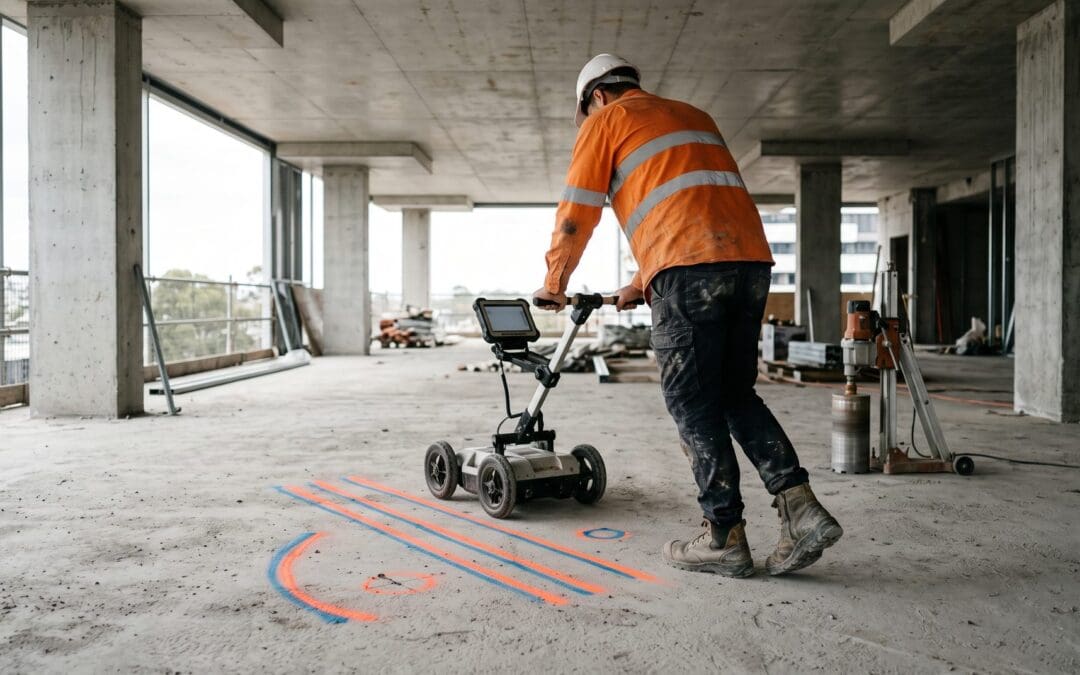
GPR sends radar pulses into the concrete from the surface and reads what reflects back. It is the same technology we use for ground penetrating radar for buried services, run at a higher frequency so it resolves fine detail such as bar spacing in a slab. The operator works from one face only, there is no radiation, and so there is no exclusion zone.
The scan is read live. Marks go straight onto the concrete in front of your crew, so the person holding the core drill is looking at the same information as our operator. A pre-coring scan picks up:
- rebar and steel mesh
- post-tension and pre-tension cables
- pipes, conduits and electrical wiring cast into the slab
- voids, cracks and deterioration
- the safe positions to core
Where the job needs a record, our in-house drafting team can issue the scan as a plan in 12d, DWG or PDF, the same formats we use for utility mapping.
Concrete x-ray vs GPR: the practical differences
Access to the slab
Radiography needs both faces of the concrete. GPR needs one. On a slab on ground, or a wall with no access to the far side, that alone settles the question. Where a slab is reachable from one face only, GPR can also give an indication of its thickness from the return off the back of the slab.
Disruption on site
Radiography brings an exclusion zone and licensed radiation controls with it. GPR brings neither, so other trades can keep working nearby. In an occupied building, our 24 hour service means a scan can be done outside occupied hours instead.
Where GPR has limits
GPR is not unlimited. Heavy reinforcement, high moisture content and dense mesh all reduce what the radar can see through, and an anomaly on screen cannot always be identified on its own. That is why our operators record a confidence level against each target and confirm on site what a scan can achieve, rather than promising a result in advance. If a structural engineer has specified radiography for a particular element, follow the specification.
Which one you need before coring, cutting or drilling
For the three jobs behind most concrete scans, GPR is the practical choice:
- Before coring: plumbing and electrical penetrations, riser holes and drainage, where the hole has to land where the reinforcement is not.
- Before cutting: saw cuts through slabs, walls and decks for openings, stairs and lift shafts. A saw does not stop when it finds a cable.
- Before drilling: anchor bolts, hold-downs and fixings for balustrades and plant. Even shallow drilling reaches mesh and conduit.
On a post-tensioned deck, ask for the whole penetration footprint to be scanned rather than a single point. Tendons curve through the slab, so a clear point does not mean a clear hole, and cutting a post-tension cable is a life-safety event as well as a structural failure.
Our locator surveyors are CertLoc accredited, and the same crews handle GPR scanning in the ground and in the slab. If you are not sure which method your job needs, send us the slab type, what you are penetrating and when you need it done. Call (02) 8753 0049 or request a concrete scan.