
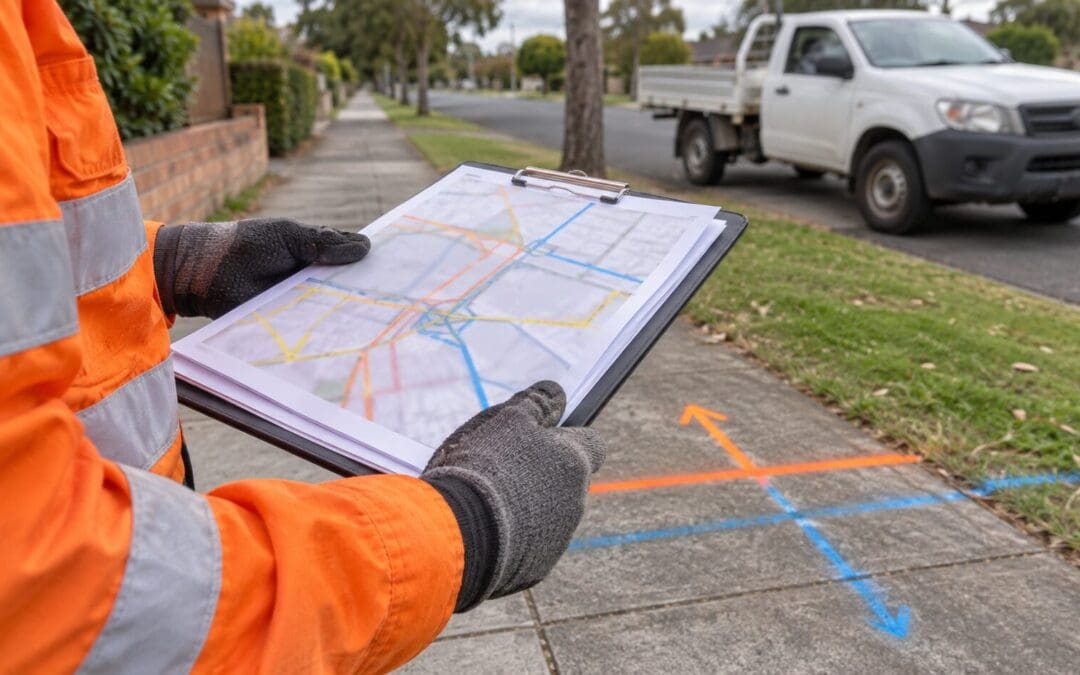
Dial Before You Dig NSW: the short answer
Dial Before You Dig NSW rules come down to three points. The service is free, anyone can use it, and if you are excavating near gas or electricity networks in NSW, using it is the law. The service is now called Before You Dig Australia (BYDA), though most people still call it Dial Before You Dig. You lodge an enquiry, the asset owners near your site respond with their plans, and those plans tell you what is likely to be under the ground before work starts.
This guide covers the cost, the NSW requirement, how to lodge and how to read what comes back. On our own jobs the BYDA plans are the first thing we collect, before a single service is traced on site. If you need services found and marked on the ground rather than plotted on a plan, that is the work of our utility locating team in Sydney.
Is Dial Before You Dig free?
Yes. BYDA states that it is free to lodge an enquiry. You can lodge through the BYDA website or the BYDA app for iPhone and Android. The 1100 number is BYDA’s helpdesk for help with logging in, not a way to lodge an enquiry.
Anyone planning to work around underground assets should lodge one, and that includes homeowners. A fence, a garden bed or a new water tank all involve digging, and the plans cost nothing.
Is Dial Before You Dig a legal requirement in NSW?
Yes, near gas and electricity. According to BYDA, NSW is currently the only state where using its referral service before excavation is a legal requirement. The obligation sits in the Electricity Supply Act 1995 and the Gas Supply Act 1996, which name BYDA as the designated information provider, and it applies to anyone excavating near gas and electricity networks.
BYDA says the requirement covers almost all work on private property, including work approved by a council. Emergency work and potholing to find underground networks are exempt. As at November 2026, BYDA lists the penalty for interfering with electricity or gas works at $22,000 for individuals and $440,000 for corporations, with a maximum jail term of five years.
Plan age matters too. Ausgrid states that underground electricity cable plans must be no more than 30 days old when excavation starts.
How to lodge a BYDA enquiry
The enquiry itself takes a few minutes.
- Mark the dig site on the BYDA map, covering the whole area you will disturb.
- Describe the work and when it will happen.
- Check the Enquiry Confirmation Sheet. It lists the affected asset owners in your area, with their contact details.
- Collect the responses. BYDA encourages its members to respond within two business days. If an asset owner has not replied, contact them directly using the details on the confirmation sheet.
Lodge before you lock in a dig date, so the response window does not hold up the job. If the work moves outside the area you lodged, or the plans expire, lodge a new enquiry.
Two gaps are worth knowing about. Not every asset owner is a BYDA member, although most are. Private services, such as a line running from the meter to a shed, are not on any plan at all. A set of plans that shows nothing near your dig is not proof that nothing is there.
How to read Dial Before You Dig plans
Each asset owner responds separately with its own plans or information pack, so the sheets will not look alike. Work through them one at a time with three checks.
Start with the legend
Colours, line types and symbols differ between asset owners, so read each legend before reading the drawing. BYDA points to the legend for details such as gas pressures, and advises contacting the asset owner directly if a plan or information pack is unclear.
Check the expiry date
Every set of plans carries an expiry date, on the plans or in the information pack, and it varies between asset owners. Once plans expire, BYDA requires a new enquiry so that current plans are always on site. For Ausgrid cables, the 30 day limit applies when excavation starts.
Treat the route as a guide
Plans show where a service was recorded, not where it sits today. BYDA tells users never to assume the depth or alignment of pipes and cables, and in most cases asset owners do not supply depth at all. We explain why in how often Dial Before You Dig records get the depth wrong.
What to do once the plans arrive
The plans tell you which services are likely near your dig. The next step is finding them on the ground. A locator traces conductive services such as power, gas and water mains with electromagnetic detection, and uses ground penetrating radar for plastic pipes, clay sewer and conduit that will not carry a signal. Each service is then marked on site.
Where you have to dig close to a service, or a design has to clear one, potholing exposes it so the depth is measured instead of estimated. That work is done by vacuum excavation, which lifts the soil away without a bucket touching the asset.
Locate & Map’s locator surveyors are CertLoc accredited and start every locate from the plans. Send us your BYDA plans and the area you need cleared, and we will tell you what needs locating. Call (02) 8753 0049 or book a service locate.