
Start with a free Before You Dig Australia request
If you need to locate underground services before you dig, the first step is free and takes a few minutes. Lodge an enquiry with Before You Dig Australia (BYDA), the service most people still call Dial Before You Dig. Asset owners such as Sydney Water, Ausgrid and the major telcos respond by email with plans showing what they have registered near your site, and BYDA asks its members to respond within two business days.
Read those plans for what they are. They confirm that services are likely present and give an approximate route. They do not pinpoint the position, and in most cases they carry no depth at all, because the asset owner has no record of what has happened to the ground since the pipe or cable went in. Private services, such as a line from the meter to a shed, are usually not on any plan. We covered the depth question in detail in why Dial Before You Dig plans skip the depth.
So the plan tells you where to look. Finding the service is the next job, and BYDA’s own advice is to consider engaging a skilled locator to do it.
How a locator finds each type of service
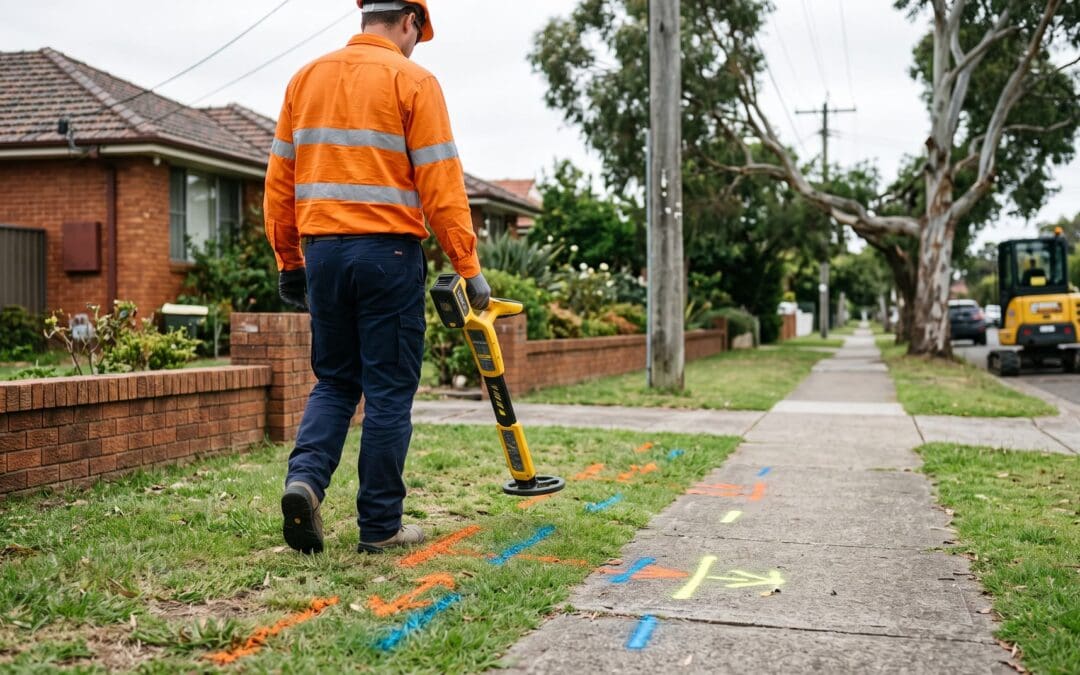
A locator works through a site in a set order: plans first, then a sweep for anything conductive, then a trace of each known service, then radar for whatever the first two passes cannot see. Two detection methods do the work, and each covers the other’s blind spot.
Metal pipes and cables: electromagnetic locating
Most of what runs under a Sydney property is conductive: water mains, gas, electrical, telecommunications and fibre in copper-traced conduit. Electromagnetic locating puts a signal onto the service, by clamping to it, connecting at a pit or valve, or inducing it through the ground, then reads the field from the surface. That gives the alignment of the line and an estimated depth, and it can follow one cable through a corridor full of others.
A passive sweep comes first. It reads the mains power and radio signals already present on long metal conductors and flags that something is there. It will not tell you what. That is why the active trace follows.
Plastic water pipes, clay sewer and fibre: ground penetrating radar
Electromagnetic locating fails on anything that will not carry a signal: PVC water mains, clay sewer, plastic gas and fibre conduit with no tracer wire. Ground penetrating radar finds those because it responds to a change in material rather than to metal. It also shows buried tanks, old slabs, backfilled trenches and voids.
Radar has limits of its own. Dry sandy ground suits it. Clay-rich profiles across parts of western Sydney, and any site after sustained rain, cut its penetration, and a tree root, a rock and a plastic conduit can all present in a similar way on screen. An experienced operator records a confidence level against every target rather than presenting radar as certainty.
Can you hire a locator and find them yourself?
You can hire the equipment. What you cannot hire is the reading. A passive sweep shows that a conductor exists, radar shows an anomaly, and interpreting both is where the operator matters more than the unit. Antenna choice alone changes what radar can see: lower frequencies reach deeper with less detail, higher frequencies resolve fine detail and stop short.
There is also the record. Under AS 5488, the Australian standard for classifying subsurface utility information, a field-detected locate is Quality Level B. QL-B is what a Safe Work Method Statement typically calls for before trenching, and it requires the method, the equipment, the survey date and the operator’s qualifications to be recorded with the result. Locate & Map’s locator surveyors are CertLoc accredited, previously known as BYDA accreditation, and every job is classified against the standard. A hired wand and a can of paint do not produce that record.
How to confirm the depth before the bucket goes in
A locate tells you where a service most likely sits. If a footing, trench or bore has to pass close to it, the next step is to expose it. Vacuum excavation, also called potholing, breaks the soil with pressurised water or compressed air and lifts it into a tank, so the pipe or cable is uncovered without a bucket tooth touching it. The crew measures the true depth, size, material and offset, then backfills.
That measured exposure is Quality Level A under AS 5488, the level that turns an estimate into a fact. Hydro excavation is faster in the clay and compacted fill common across western and south western Sydney. Air excavation keeps the spoil dry so it can go straight back in the hole, which suits sandy ground and work around sensitive electrical assets.
What you should have in hand before you dig
By the end of the process the surface is marked, every located service carries a quality level, and the results are drawn up in 12d, DWG or PDF so they can go straight to whoever is designing or digging. A radar result comes back the same day the crew is on site, and same-day and next-day bookings are available across metropolitan Sydney.
That applies whether it is a single pit on a domestic job or staged verification across a construction program. Call (02) 8753 0049 or book a locate online with your site address and what you are planning to dig.