
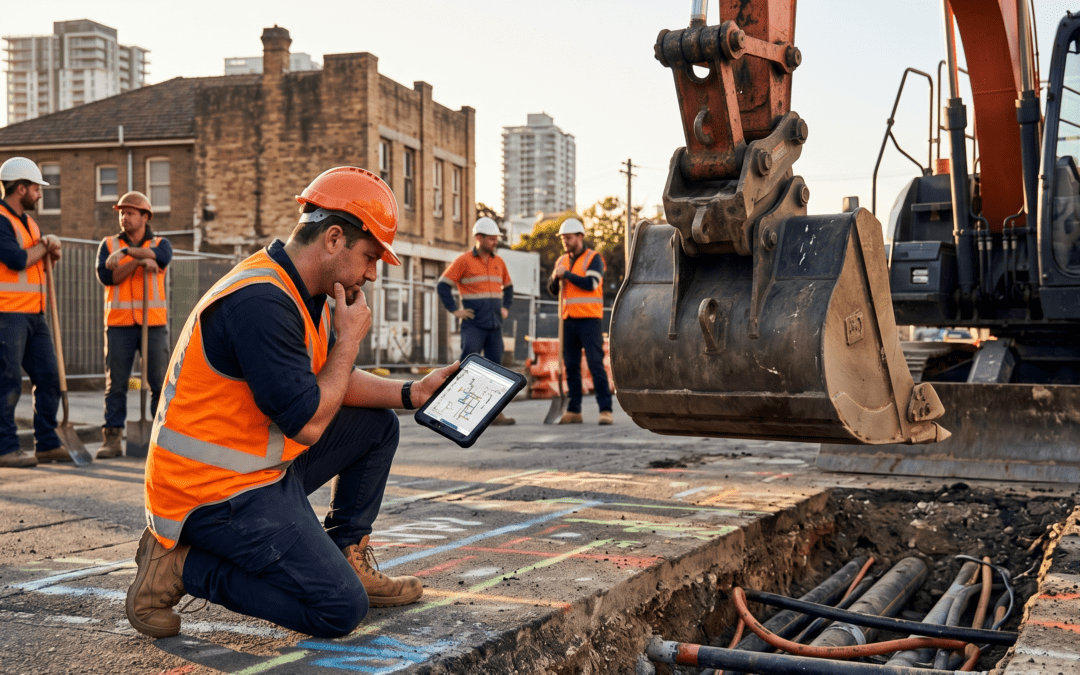
Most conversations about utility strikes focus on the repair bill. The cable gets fixed, the invoice gets paid, and everyone moves on. But on a live construction programme, the repair is rarely the expensive part. The delay is.
A strike on an unmarked service does not just stop one task. It stalls the work that was supposed to follow, which stalls the work after that. By the time the trench is backfilled, you have lost days you cannot get back, and the cost of those days is spread quietly across the whole job.
Here is how unmarked utilities turn into schedule damage, and why the time cost is the one that hurts margins most.
The strike is the start, not the end
When a digger hits an unrecorded cable or pipe, the immediate response looks the same every time. Work stops. The area is made safe. The asset owner is called. And then everyone waits.
That wait is the problem. You do not control when the asset owner’s crew arrives, how long the repair takes, or when they sign off on the area being safe to work again. On a busy week across Sydney, that response can stretch from hours into days.
Before You Dig Australia’s research into the national cost of strikes counts both direct and indirect damage, and the indirect side is where delay sits. Their figures put the total economic burden in the billions each year, and a large slice of that is not repair work. It is lost time, lost productivity, and knock-on disruption to projects that were running to schedule until a buried service got in the way.
How one delay becomes many
A construction programme is a chain. Each task depends on the one before it. When an unmarked utility stops an early task, the delay does not stay contained. It travels.
Picture a site where excavation feeds straight into footings, footings into slab, slab into frame. A strike during excavation pushes the footing crew back. They may not be available the day you are finally ready, so they get rebooked for later in the week, or later in the month. The concrete pour you had locked in slips with them. The trades booked behind the pour arrive to a job that is not ready, and some of them charge for the wasted trip.
Each link in that chain adds cost. Standing time for your own crew and plant. Rebooking fees from subcontractors. Idle hire equipment that keeps clocking up charges whether it moves or not. None of it appears on the utility repair invoice, but all of it lands on your bottom line.
The contract costs nobody mentions at the strike
On commercial and civil projects, time is written into the contract. Many head contracts carry liquidated damages clauses, which charge the builder a set amount for every day the project runs past its agreed completion date.
If a string of utility delays pushes you past that date, those daily charges start to apply. A delay that began with a single unmarked cable can end up costing far more in liquidated damages than the strike itself ever did to repair.
Then there is the relationship cost. Clients and head contractors keep score on who delivers on time. A project that runs late, especially for a reason that looks avoidable, follows a firm into the next tender. In a market as connected as Sydney’s, reputation moves fast.
Why unmarked services are so common here
The frustrating part is that the services causing these delays are often not on any plan.
A Before You Dig Australia request returns plans from asset owners, but not every owner is a member, and private services on a property are rarely recorded at all. A line running from a meter to an outbuilding, an old irrigation pipe, an abandoned conduit that still carries a live cable: none of these reliably show up.
Older Sydney suburbs are full of this kind of legacy infrastructure. Decades of changes, repairs, and ground movement mean the real layout below the surface often does not match any record. The plan looks clean. The ground tells a different story.
That gap between the record and reality is exactly where the costly surprises live.
Turning a guess into a programme you can trust
The way to protect a schedule is to remove the unknowns before work starts, not discover them mid dig.
A physical survey takes the records you have and tests them against what is actually there. The full range of locating and mapping services at Locate & Map combines electromagnetic location and ground penetrating radar to trace metallic services, find non-metallic ones like plastic pipes, and pick up unrecorded assets that no plan would have shown. The output is a marked, verified picture of the subsurface your crew can plan around.
On larger civil and construction projects, that picture becomes even more valuable as a planning tool. 3D utility modelling lets engineers and project managers see existing services in context, coordinate new installations between trades, and design excavation that avoids conflict before a single bucket moves. When everyone is working from the same accurate model, the surprises that cause delay simply have fewer places to hide.
The maths that should settle the decision
Set the cost of a survey against the cost of a delay and the choice gets clear.
A locate is a known, fixed cost you can build into the programme. A delay is an open-ended one. It compounds through standing time, rebooked trades, idle plant, possible liquidated damages, and a dented reputation. The survey protects all of that for a fraction of what one serious delay can cost.
The firms that keep getting caught treat locating as an optional line to cut when budgets get tight. The firms that finish on time treat it as part of site setup, the same as fencing or traffic management. They are not paying to avoid a repair. They are buying back the certainty that keeps their programme on track.
If you have works coming up across Sydney and want the ground verified before it can cost you days, speak to the team at Locate & Map about planning a survey around your programme.